

Facility management breaks down when building knowledge fragments across spreadsheets, emails, and outdated PDFs. Digital twin facility management is transforming how teams maintain operational continuity – not through fancy 3D visuals, but through living building records that preserve what exists, what changed, and why.
Why Traditional FM Documentation Fails
Every facility undergoes constant evolution: spaces reconfigure, systems get serviced, infrastructure disappears behind finishes. Yet most documentation becomes obsolete the moment it’s filed away. The result? Every maintenance issue becomes a research project, audits turn into evidence hunts, and renovations rely on guesswork.
STAGES addresses this by creating one continuous digital record of your facility, connected across time. This isn’t about visualization – it’s about operational intelligence.
The Real Cost of Fragmented Building Knowledge
Documentation exists everywhere, which means it’s effectively nowhere
FM work demands context: installation dates, modification history, approval records, before-conditions. When this context scatters across drives, PDFs, and email threads, teams waste hours searching before they can act. STAGES makes building documentation browser-accessible while linking it to construction history for maintenance and renovations.
Location uncertainty doubles incident impact
The slowest part of fixing failures isn’t the repair – it’s locating the right element and understanding what changed since the last intervention. If knowledge lives in one person’s head, response depends on shift schedules. If it’s buried in email, response depends on search skills.
Digital twin facility management matters when it provides visual truth and timeline reconstruction. STAGES enables this through stage-based organization, letting teams verify past conditions in consistent spatial context.
Audits require proof, not explanations
When evidence scatters, audits become expensive evidence-collection exercises. STAGES positions teams to approach compliance with documented proof inside the building’s history, turning stress into confidence.
Renovations create hidden condition risks
Systems modified during upgrades vanish behind finishes. Months later, a ticket arrives and teams face uncertainty: exact location, routing details, what moved. Without stage comparison, costly destructive checks become necessary.
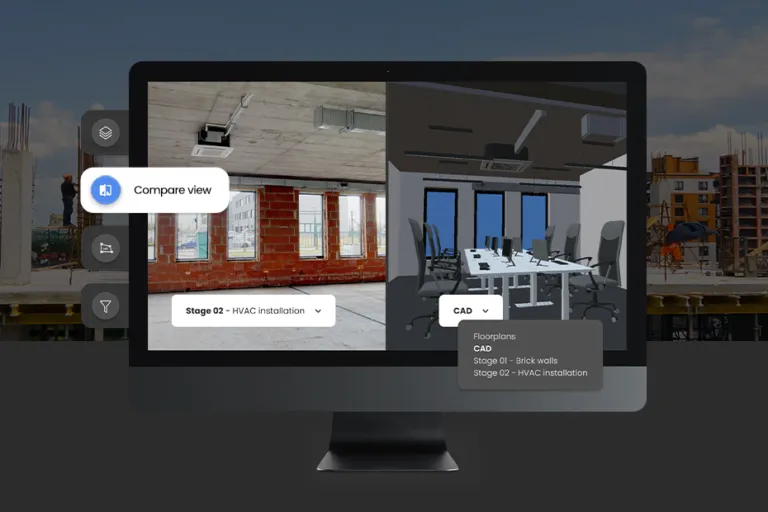
STAGES enables side-by-side stage comparison, shortening investigation phases and reducing blind work.
How STAGES Transforms FM Operations
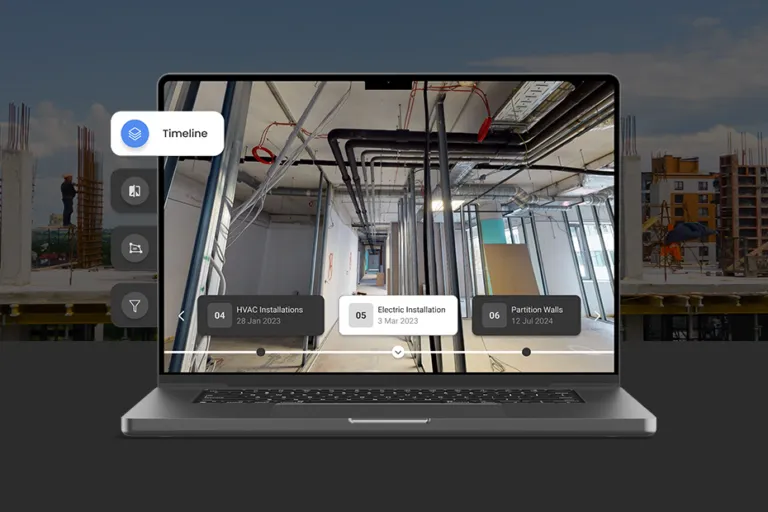
Timeline: When buildings have memory, not just files
The biggest FM enemy is lack of chronology. STAGES uses a timeline approach to organize building stages, enabling movement between phases while maintaining orientation. Incidents don’t start with “where’s the latest file?” but with “which stage shows this condition?”
Split screen: Immediate stage difference visibility
Many FM issues are differences, not single states. Something routed differently, became concealed, disappeared. Side-by-side stage comparison resolves uncertainty instantly, reducing costly site visits.
Notes and reporting: Location-anchored communication
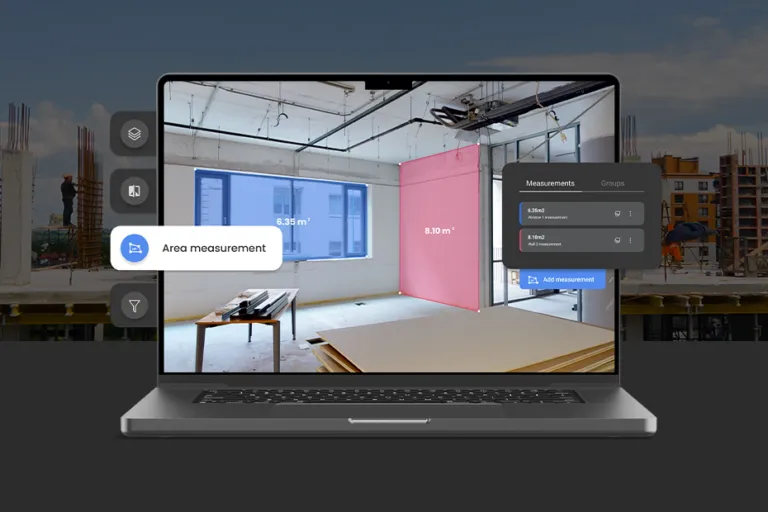
Communication without spatial context degrades over time. STAGES anchors issues to places, enriches them with evidence, and keeps status visible. This closes the loop from observation to documentation to handover to verification.
Access control: Shared truth with security
Contractors need context, compliance needs order, ownership needs control. STAGES manages access and permissions so different parties see only what they need.
Real-World FM Scenarios
Scenario 1: Mystery ticket after multiple upgrades
Traditional workflow: Site walk, phone calls, email searches, extra confirmation visit.
Digital twin workflow: Review historical context, compare stage, document in place, hand to vendor with complete context.
Scenario 2: Audit preparation
The expensive part is gathering evidence. When documentation ties to building history and spatial context, presenting a coherent story becomes straightforward.
Scenario 3: Renovation planning
Building history and stages let teams analyze before/during/after conditions without repeat visits, reducing operational disruption and intuition-based decisions.
Getting Started Without Overwhelming Rollout
Effective FM rollouts start with one facility and one pain point. First, establish organizational environment with team invites and access rules. Then launch a project, connect first as-built capture for baseline. Add stages, and shift into a consistent loop: check history, compare stages, document issues, hand off, maintain evidence trail.
For advanced engineering data needs, extend workflow with the desktop app supporting broader format compatibility.
Try for free with one project and one repeatable process like issue handling or audit readiness. For portfolio rollout and governance, contact sales.
FAQ
Is digital twin facility management only for new construction?
No. STAGES is positioned for facility lifecycle including operations and maintenance, providing building history access when FM needs it most.
What differentiates 3D models from digital twins in FM?
3D models show space. Digital twins support decisions: preserving change history, enabling stage comparison, tying evidence and communication to place and time.
How do we share with contractors safely?
Through platforms supporting access control and controlled sharing – essential for FM collaboration without losing governance.
Is web version sufficient?
Web suits collaboration and multi-device access. Desktop helps with advanced data and broader format compatibility.
Digital twin facility management only matters when it connects change history, stage comparison, and communication to where work happens. STAGES builds around this logic, keeping building knowledge alive and usable.